Navigating the era of zero-click content

Digital marketing has always come with moving targets. Just as one approach starts to work, the rules change. Zero-click is the latest example.
Zero-click refers to content that answers a user’s question directly on a platform, without requiring them to visit a website. This happens on Google, AI search tools, LinkedIn, TikTok, YouTube, and others.
Platforms are rewarding content that keeps users where they are, which creates tension with traditional marketing advice that says every piece of content pushes toward a website visit. In many cases now, adding a call to action is an extra step that can reduce reach.
Around 60% of Google searches end without a click, and that figure is rising as AI-generated answers become more common. Social platforms are doing the same, favouring native, in-platform insight and posts without links.
The result is less website traffic, even when your content is still doing its job. It can build awareness, answer questions, and shape decisions without ever generating a click.
Below we share how to think about this change and what actions to take, which include:
Rethinking search marketing’s role in your strategy
Developing social content with insight
Understanding the convergence of search and social ecosystems
Revisiting which metrics to tell a better story of influence
Rethinking search marketing’s role in your strategy
A common concern is what this means for SEO, especially in niche areas like FDI or talent attraction. Search visibility still matters, but the goal is broader now. Being cited or summarised by AI tools is just as important as ranking on a results page, as that first line of discovery is increasingly outsourced to AI conversations.
Place-related queries are complex, but AI tools are getting better at summarising them. As a result, the point at which someone becomes influenced is moving away from websites and toward featured snippets, AI summaries and “People Also Ask” sections.
For EDOs and place brands, that changes the focus. Some helpful actions include:
Focus on topics, not just keywords. Define 5-10 core themes you want to be known for (for example: advanced manufacturing, cost competitiveness, talent pipelines). Build multiple pieces of content around each so search engines and AI tools can clearly associate your place with those areas.
Build connected content. When a sector page links to talent availability, cost data, case studies, and infrastructure, it forms a complete picture that helps search engines understand your strengths and gives users everything they need without having to search elsewhere. The problem is that too many place brands are still missing valuable and in-demand topics on their website that relate to a decision process.
Incorporate an FAQ section. AI tools prefer content that sounds like a human, not sentences written for web crawlers. While that can be difficult to pull off in the typical structure of a website, frequently asked questions are usually much more conversational in tone. Basel Area Business and Innovation’s new website does this masterfully.
Your website now serves two purposes. First is to have the structured information to be found by search and AI crawlers. Second is to provide the insight and clear narrative that compels action when a person does visit.
Developing social content with insight
In a zero-click environment where users consume information directly within search results and social feeds without leaving the platform, the focus of content differentiation is becoming more about authority than volume.
That means content should stand on its own. It should be clear, specific, and easy to consume without context. This reframes content strategy: instead of treating platforms as distribution channels, they must be treated as destination environments that build your brand, educate, and drive engagement. Content needs to be self-contained, insight-led, and engineered for in-platform consumption.
Formats matter here. Carousels, short videos, and simple visuals perform well because they match how people consume information. When those formats include real insight, they also build credibility.
Instead of large, one-off pieces, it is more effective to break ideas into smaller outputs:
Turn one topic into a series. For example, a single report or insight can become a week of LinkedIn posts, a short video, and a simple visual that each cover one angle of the same theme. Better yet, do them all – content is often only seen by a smaller fraction of your followers, so multiple posts on a similar topic will maximize that single theme’s reach.
Prioritise original data and examples. Content that includes real numbers, case studies, or first-hand insights is more likely to be shared, referenced, and picked up by AI tools than general commentary.
Design content to be reused by others. Clear takeaways, simple charts, and quotable insights increase the chances your content is referenced in AI summaries, presentations, or industry discussions. Greater Zurich Area served up a masterclass of virality with its AI ecosystem map, which has been reposted, shared, and continually evolved as more companies are added for the last two years.
Understanding the convergence of search and social ecosystems
Search and social are on a collision course, where they are increasingly feeding each other.
Recent data from SEMrush shows that platforms like Reddit and LinkedIn are among the most cited sources in AI-generated answers, alongside YouTube, Medium, and Facebook. In other words, the content shaping search results is increasingly coming from social platforms.
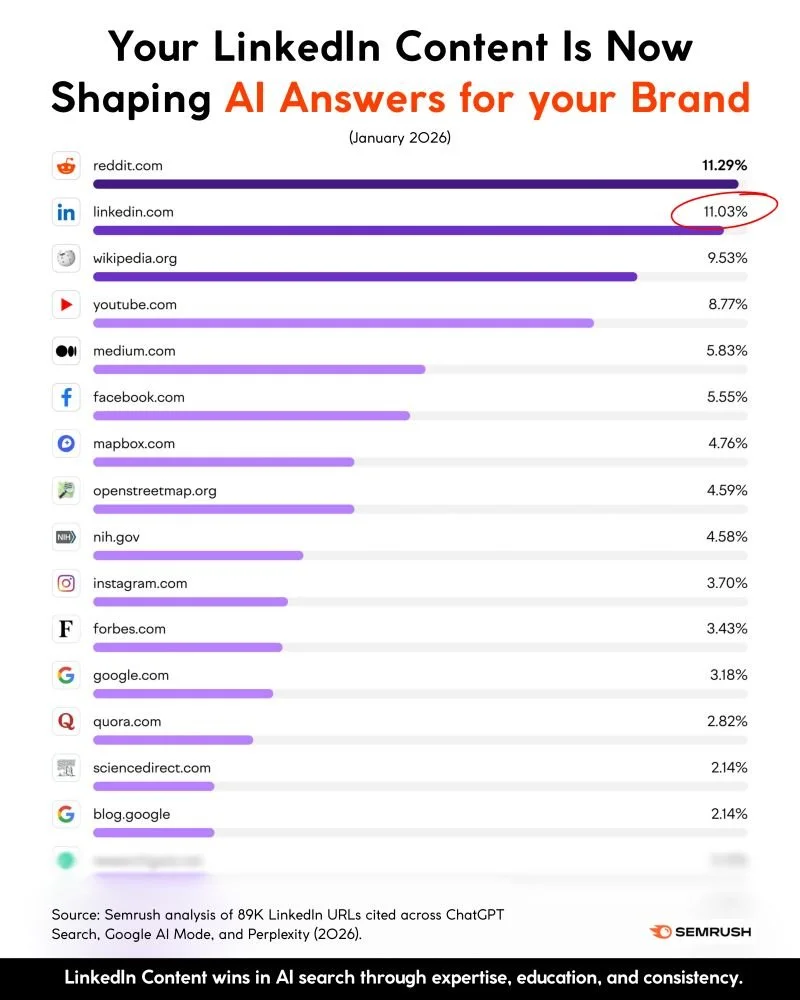
This changes how visibility is earned, extending beyond Google to showing up in the other places where AI tools are pulling information.
For EDOs and place brands, that creates a new set of priorities:
Treat social content as search assets. A well-structured LinkedIn post or Reddit discussion can now influence how your location appears in AI-generated answers, not just how it performs in a feed.
Focus on credibility over promotion. Content that explains, answers questions, or shares first-hand insight is more likely to be referenced than campaign-style messaging. The marketing “spin” is not landing with audiences the way it used to.
Create content that stands on its own. If AI tools are pulling from social posts, each piece needs to make sense without context, with clear takeaways that can be easily quoted or summarised.
Revisiting which metrics tell a better story of influence
The most visible impact of zero-click is lower website traffic. That can be difficult when traffic has been a core KPI. But the more important question is: was traffic ever the real goal anyway?
It used to be the primary way to correlate interest in our locations, but as visitor volume lessens in significance, other metrics gain value. The role of content as an authority builder, educator and scene-setter has not disappeared, but it has become harder to track in the same way.
Metrics like impressions, views, and engagement are often dismissed, but they now carry more weight. They show whether your content is being seen and whether it is resonating.
There is also more sharing happening in private channels, aka “dark social,” where attribution is limited, but influence is arguably at its greatest. More than ever, content can influence decisions without leaving a clear trail.
As a result, performance needs to be read differently:
Align around “influenced conversions.” Not every investment lead or talent application will come directly from a tracked click. Build internal agreement that marketing supports deals through multiple touchpoints, and track assisted conversions through CRM notes, surveys, and sales feedback.
Get your data house in order. If you cannot connect content, campaigns, and outcomes across systems, you will default back to last-click thinking. Clean up tracking, standardise UTM usage, and make sure marketing and business development teams are working from the same data.
Track engagement from target markets, not just totals. A spike in global impressions means little if it is not coming from priority countries or sectors (see our most commonly misread metrics). Focus reporting on whether the right audiences are seeing and interacting with your content.
Website visits still matter, but they are only part of the picture.
Zero-click content is changing how people interact with search and social. The focus is moving from driving traffic to delivering value where people already are.
For EDOs and place brands, the approach is not to fight this shift, but to work with it. Be useful on-platform, build trust over time, and make sure your content is easy to find, understand, and reuse.